pennylessnick.

New Roommate

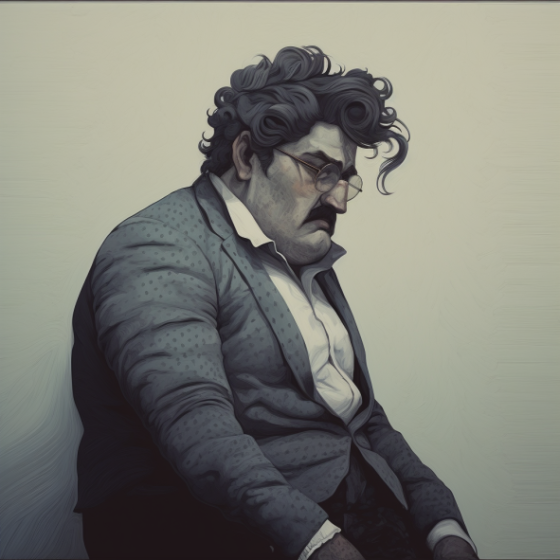
“Cosplay”, that was his one-word explanation for the absurd wardrobe, offered without irony, on a sultry Trivandrum summer afternoon when the air itself seemed too heavy to permit even the thinnest linen, and yet he wore black in layers, as though neither heat nor humidity affected him.

I had only just returned from the hospital, still holding the folded prescription that pronounced my blood pressure “elevated.” A phrase so bland, so politely bureaucratic, it sounded less like a medical warning than the veiled hint of a landlord threatening eviction.

The fluorescent corridors, the faint smell of disinfectant, the slow shuffle of other patients, these clung to me as I pushed open the door of my flat, expecting emptiness, and instead found him. He was already there, seated at the kitchen table with the composure of someone who had always belonged to the room, polite enough to nod but not to smile, his black garments resembling less the clothing of a man than the ceremonial costume of someone convinced that this world, in all its damp heat and crumbling plaster, was merely a stage on which he had been waiting for me to arrive.

Compared to my previous roommate, whose bathroom kombucha experiment had nearly driven me out by smell alone, this new one seemed tolerable, even welcome. He mostly kept to himself, was punctual with rent, not given to midnight parties or loud declarations of entrepreneurial destiny. He didn’t even doom scroll with the sound on. His only eccentricity was the wardrobe, row upon row of indistinguishable black coats he hung in the closet beside mine, so numerous they seemed not chosen but issued, like a uniform for a profession he declined to name.

I told myself it was harmless. People collect worse hobbies than cosplay.

At dinner I found myself speaking too much, filling the silence with anecdotes of work, trivial observations, a stream of chatter that embarrassed me even as I produced it, until, catching his steady gaze, I confessed with a nervous laugh that I only talked this way to keep from falling asleep, that I had not been sleeping properly at night. He did not return the laugh, nor even nod, but said instead, in a voice so flat it stripped the words of comfort, “Sleep more,” and though it sounded like advice, it carried the weight of command, as if he had said “Breathe” or “Obey gravity.”

I often felt a discomfort around him I could not name, though I laughed it off, even later when, half in jest, I asked if I might borrow one of his endless black shirts for a funeral (for my life by then had tilted, imperceptibly but unmistakably, toward funerals rather than weddings), and he refused, saying, “They don’t suit anyone else,” with a finality that was not unkind but immovable, and I knew by the chill that followed that he had spoken not merely of clothing.

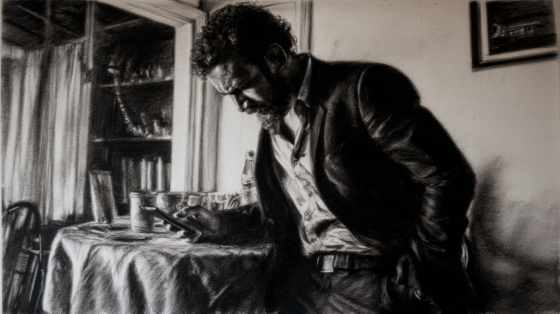
I ignored the unease, as I ignored the new grays multiplying at my temples faster than seemed fair for my age, or the sudden tightness in my chest that woke me one night and sent me staggering into the living room where he sat motionless, scrolling endlessly through his phone, not startled by my intrusion nor alarmed by my breathless state, only glancing once as if to acknowledge that he had already taken this scene into account, and then back to his screen, where I imagined he must be reviewing the endless feed of lives like mine, each post another fragile timeline edging toward its end.

Of all our interactions, the one that unsettled me most happened one afternoon as I was crossing a street. A car swerved at the last instant, missing me by inches, and when I looked up, heart pounding, skin slick with the shock of almost, I saw him leaning against a lamppost in that ridiculous cloak, watching with neither alarm nor surprise, as though merely confirming that this was not the moment, but that a moment would come. He didn’t mention it later that night when I wanted to talk about it, he pretended to not hear me. I figured that from his vantage point, it might not have looked that scary, although, as absurd as it may sound, a fleeting thought entered my mind that he was the one driving that car. Even though it would have been physically impossible.

Just as it would have been absurd for me to accuse him of any deliberate sabotage in the way the bread seemed to grow mold almost before the packet was opened, or the bananas collapsed into black pulp overnight as though unable to withstand another day in his company, or the milk turned sour in unopened cartons despite the date printed confidently on their sides, so too it would have been unreasonable to hold him accountable for the slow withering of my succulent, a plant that, by all logic, ought to have thrived in neglect, gifted to me by a colleague with the assurance that it required almost nothing or for the small goldfish, innocent and thoughtlessly purchased, that floated belly-up after only three days. And yet, taken together, these small betrayals of life gave the impression that nothing endured long in his presence, not because he had lifted a finger against them, just as he had never lifted a finger against me, but because they seemed, in some silent, unspoken recognition, to yield themselves up to him, as if in deference.

I told myself, constantly, stubbornly, that he was nothing more than a roommate with peculiar habits, that the spoiled food, the sleeplessness, the gray hairs, the near-misses and funerals, were all coincidences, the ordinary scatter of adult life, and that my unease was merely fatigue.

But denial, like all things, frays in time, and what came to me at last was not the sudden shock of revelation but the slow, inevitable settling of dust after a door has closed.

He was no hobbyist, no eccentric cosplayer, not even, in truth, a guest within my home. He had been here before me, he is here still, and he will remain long after I am gone.

Death has always been my roommate. And I, just his tenant.

On Kafka

Franz #kafka, by all accounts, led a thoroughly unimpressive life. He was an insurance clerk. An argument can be made that it is the sort of job you take when you’ve already given up on having a calling, and he spent his evenings writing things he was pretty sure no one wanted to read. He was chronically ill, socially detached, and riddled with self-doubt. The man basically specialized in existential dread and tuberculosis.

In his lifetime, he published a handful of short stories. Nothing major and certainly nothing that would make you think, “Ah yes, here is a literary titan in the making.” His novels, The Trial, The Castle, Amerika, were left incomplete, which feels appropriate given how much he doubted they were worth finishing. He died in 1924, telling his friend Max Brod to burn the lot. Straight to the flames, please and thank you.

Max, being either wildly disobedient or secretly clairvoyant, did the exact opposite. He published it. All of it, that is, the unfinished drafts, the notes, the existential ramblings. And somehow, people read it. Then scholars read it. Then critics called it genius. Today, Kafka is a literary monolith. He has an adjective #Kafkaesque, all to himself, which is more than most popes can claim.

The dude died thinking he was irrelevant. He died knowing he was a failed writer whose best legacy might be a properly filed insurance claim. Meanwhile, after he kicked it, the world decided he was a prophet of modern alienation. He never knew. Never got to bask in the praise, nor sign an autograph. Never saw the lectures not the fanfare.

Imagine that, spending your whole life convinced you were shouting into the void, only to never find out, that the void was listening.

Conviction is now filed under, “It depends”

There’s a show called After Life, which is one of those deceptively simple Ricky Gervais projects where he plays yet another emotionally defunct man with a wit sharp enough to be classified as a weapon.

The plot is straightforward, his wife dies, and instead of doing the societally approved grieving routine (cry, journal, eat icecream in your undies, pretend to heal), he decides to live in a way most people only threaten to do, completely indifferent to consequences, charm, or pants that fit.

Tony, the character, is not “trying to find meaning.” He’s not “processing trauma.” He’s just done. He’s done pretending that any of it matters. He is, how do I put this, philosophically nuclear.

And like Gervais himself, Tony is a staunch atheist, the kind who prefers drowning to being saved by someone who prays.

And then there’s this scene.

Without too much of series recap, He meets a kid. Tiny and bald. Clearly one of those “here to emotionally destabilize you in under three lines” characters. She has cancer, obviously. Perfectly poised to snap a misanthrope out of his existential coma. She asks him if he believes in Heaven.

And suddenly, everyone tenses. His friend. The air. Me, on my third rewatch, pretending I’m not about to feel anything because I’m emotionally mature and definitely not haunted by unresolved childhood detachment issues.

Now, we all know what Tony’s supposed to say. The script, the arc, the expectation. He’s going to unload something about the indifferences of the cosmos. He’s going to drop some elegant despair bomb and we’ll all nod and pretend we weren’t hoping he’d flinch.

But instead…this mf’er lies.

None of that philosophical preamble or tortured hesitation. A gentle, intentional lie while still showing on his face that he’s struggling to hold back.

He tells her what she needs to hear. just for the sake of being kind, he has to choose something else over his own conviction. Which, for a man like Tony (and Gervais) is basically a religious experience.

He does not believe in God. He doesn’t suddenly believe in heaven. He believes in protecting this small, dying person from the full weight of his personal worldview. Which, if we’re honest, most people don’t do even for their closest friends, let alone a child they met fifteen seconds ago.

And what struck me wasn’t just the restraint. It was the hierarchy. In that moment, he places compassion above truth, just for it to land heavier than any sermon because it wasn’t delivered from a pulpit, but was muttered, begrudgingly, by a man who’s spent the entire show earning the right to not give a shit.

Which brings me to me. Because, unfortunately, I watched that scene and had the deeply annoying realization that I’ve spent a lot of time thinking “being right” is the same thing as “doing right.” That conviction, the oscillation between pure white and vanta black, is more valuable than mercy. I’ve always believed that truth is a scalpel and you should use it every time someone’s confused, even if they’re already bleeding.

One of my closest friends has, over the years, tried to tell me that I tend to treat morality like a filing cabinet. She’s vehemently opposed to anything black and white. I’ve been told that I believe in justice the way accountants believe in ledgers. That empathy, for me, is mostly theoretical until the spreadsheet starts shaking (inside joke). I dismissed this, obviously. Because nothing says “you’re wrong” quite like citing logic during an emotional intervention.

But watching Tony, of all people, choose kindness instead of the usual, it hit different. A quiet, terrible reordering of priorities. I saw, clearly, disgustingly clearly, that sometimes beliefs are less important than timing.

Sometimes, the kindest thing you can do is shut the hell up and let the illusion breathe.

And that’s a sentence I wouldn’t have written two days ago.

I used to think that there is some kind of peace in truth. That caving meant cowardice. That softness was for people who couldn’t handle facts. But now I think softness is the only thing stopping facts from turning us into weapons.

And I hate that I learned this from television.

But here we are.

What a stupid, beautiful, completely unnecessary gift it is
to be wrong.

Et parfois, mentir doucement, c’est juste une autre facon d’aimer.


A rotten deal

There are stories; old, unrecorded things that only pass between lips in the dark. May be not the kind of stories you tell kids. The kind you whisper to yourself when sleep won’t come. About people who made pacts; not with gods, but with creatures that existed before gods had names. Things that live in corners of the world that maps deliberately forget.

They say some people once worshiped a “chathan”, known by many other names, but essentially a demon or some variant of it. An imp, perhaps?

Not the loud, grotesque kind from movies or cheap airport horror paperbacks. This one is quiet. Patient. It follows. It waits. It promises favors in a voice like still water. A job, a lover, a lucky number on a lottery ticket. You’d think it’s a coincidence. You think you’re clever. You think you made it happen. And the chathan laughs; a dry, brittle sound like burning hair.

The deal is simple: it gives while you live; it takes when you die. Your eternal soul for a few small worldly favors.

What anyone who ever made this deal failed to understand, in their greed or desperation, is that the chathan is inherently evil. It is the only language it knows, and therefore is not capable of giving anything good. Every fruit it gives will have a rotten core. And sometimes, most times, because it is not capable of honoring its own word, for what is honor to an imp, it doesn’t wait till you are dead to take your soul. It begins early; with small things.

Your focus starts slipping. No big deal. Just forgot your keys. Just missed a deadline. Just lost a sentence halfway through saying it.

Then the carnival kicks into high gear.

Your mind becomes a tent with its flaps open in a storm. Thoughts fly in and out. None stay long enough to be useful. There’s noise, constant noise; like ten TVs screaming in different languages. There’s static, like your brain is stuck between channels. You try to read a page and your eyes crawl off it. You try to listen and your own thoughts interrupt. There’s always a next thing; and a next thing; and a next thing. And you chase them all like a fool, hands full of nothing.

You forget people’s names. Then faces. Then birthdays. Then yourself.

Whatever happened to the smartest man in the room, the multi-talented artist, the one who had promise? You ask yourself as you’re being ridiculed by your own past, trying to cling on something that never was.

You won’t even remember making the deal. Some part of you assumes you once made such a deal. What else could possibly be responsible for this soulless existence. You accept your fate.

You live in the punishment. A sentence served without remembering the crime. You wake up every day in a body that is somehow yours and not. A brain that you pilot like a bad shopping cart; pulling violently to one side, resisting every turn. You try to fix it; with apps and journals and willpower. It’s like trying to cage fog.

You would think: Maybe I’m just lazy. Maybe I’m broken. Maybe I deserve this. And the chathan, always walking just behind you, rests its chin on your shoulder and says, “Exactly.”

And this; this soul-eviction, this fractured loop of shame and noise and forgetting; this is what they sometimes call adhd.

banana peels and unicorn dreams – unusual tales of existential dread

Why is the opposite of hope despair and not indifference?

Why is it is easier to hate when you no longer love?

Back before the brain was addled, I was a fan of Nietzsche who explained this in how own way. The oppressed never seek emancipation, it’s not in their nature. They seek a role-reversal. That’s how we get an Israel after a Holocaust, a Stalin after the Tsar, a Spanish Inquisition post-Roman repression. It’s a cycle that just keeps turning.

This pattern isn’t just confined to the history books, either. It’s present, here, today, if you look for it. It’s in the way we are tempted to fight racism with reverse racism, respond to misogyny with misandry, meet terrorism with islamophobia, and answer crime with tribal vengeance. These reactions aren’t intentional, they’re just us, listening to our deepest, most primal instincts.

It is a bug in our kernel. Tribalism, we are born with it.

This seemingly involuntary action, when continued with reckless abandon, drives a deeper wedge between a man and his hope for a solution. Yesterday’s oppressed becomes today’s oppressor, while today’s oppressed is being primed to become tomorrow’s oppressor.

The cycle didn’t start with him, and it certainly won’t end with him.

Inking my thoughts onto the page no longer holds the same innate fluidity it once did. This might be a fruitless endeavor at pattern interrupt, or possibly, it could be the dawn of an unconventional series, one of slippery banana peels and whimsical unicorn dreams.

© Copyright 2010 - 2017. Pennyless Nick. All rights reserved | Proudly powered by WordPress | Theme by ACTS 9